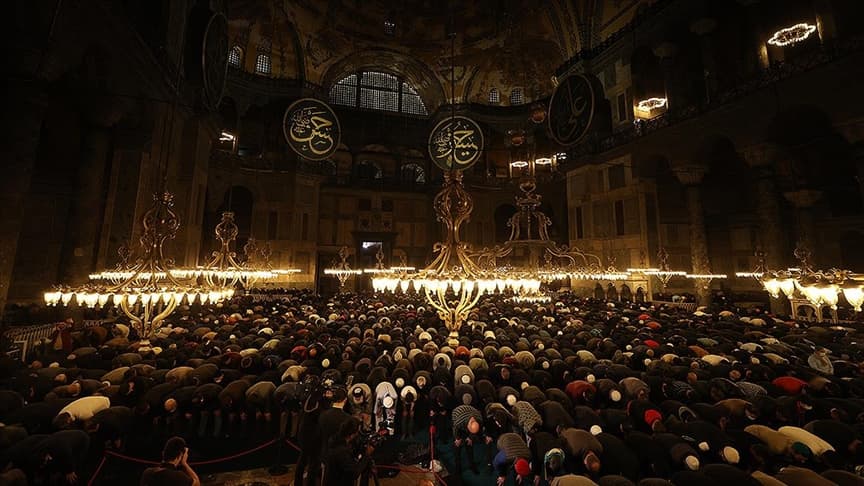
A 1500-year wait, Fatih's prostration, and the rising sounds of adhan once again.
When Istanbul was conquered in 1453, this was the first place Fatih Sultan Mehmet went. The moment he got off his horse and prostrated in gratitude, the fate of Hagia Sophia changed. The flags to the right of the minbar and the imam ascending the pulpit with a sword are symbols that this place was conquered by the 'right of the sword'. Being there knowing these details makes you feel not just like a tourist, but an heir to that conquest. Fatih's endowment deed seems to still echo on the walls: 'Whoever uses this mosque for other than its purpose...' You complete the prayer.
That famous dome deemed 'unsurpassable' until Mimar Sinan built the Suleymaniye... Standing at a height of 55 meters as if suspended in the air, this dome has astonished engineers for centuries. Beams of light entering through the 40 windows beneath it give the feeling that the dome descended from the sky. Combined with additions of Islamic art; those huge calligraphy plates and the elegance of the mihrab, a divine atmosphere emerges that makes one feel tiny. Your neck will hurt from looking up, but you won't be able to take your eyes off it.
One of the most interesting aspects of Hagia Sophia is that mosaics from the Christian era and Islamic artifacts stand peacefully under the same roof. The frescoes not being completely covered, but only veiled during prayer times, is a sign of Islam's respect for other religions and art. This tolerance makes Hagia Sophia unique in the world. Seeing both the depiction of Jesus (remaining from the museum era) and the word 'Allah' in the same frame there is like experiencing the layers of history simultaneously.
"When you enter through the Imperial Gate and look up at that huge dome, you don't just see stone and mortar. You see Justinian's ambition, Fatih Sultan Mehmet's gratitude, and the tears of those who prayed for 'chains to break' for centuries. Hagia Sophia is much more than a building; it is the soul of Istanbul, the red apple of the Islamic world. What you feel when you step on its carpets is not softness, but that sweet weight history places on your shoulders."
A prayer performed in Hagia Sophia is not an ordinary worship; it is bearing witness to history. It is impossible not to get goosebumps when the muezzin's call of 'Allahu Akbar' echoes in that huge dome and returns to you. That dim light filtering through the windows, the majesty of the green columns, and the huge 'Allah', 'Muhammad' plates on the walls... This is where East meets West, matter meets meaning. Coming to Istanbul and returning without breathing the spiritual atmosphere of Hagia Sophia means never seeing Istanbul.
